Last updated: September 28, 2026. Immigration rules change; always confirm the current requirements with El Salvador’s migration office (DGME) before applying.
El Salvador has one of the simplest retirement residencies in Latin America: a dollar economy, an income bar tied to the local minimum wage, no local tax on your foreign pension and a path to permanent residence after just one year. The trade-offs are limited public healthcare and an emergency security regime that has been in place since 2022.
Key facts at a glance
| Pensioner (pensionado) income | $1,226.40 per month from a foreign pension |
| Passive-income (rentista) income | $1,635.20 per month; $2,452.80 with two or more dependants |
| Application fee | $140 for one year or $260 for two (non-Central Americans) |
| Official response time | Up to 45 working days once the file is complete |
| Permanent residence | Can be requested after one year; $345 fee |
| Tax on foreign pension | Not taxed in El Salvador |
| Can you work? | No, with narrow exceptions for teaching or specialised public-sector work |
| Currency | US dollar |
How much income do you need?
Both retirement routes are set as multiples of the minimum monthly wage for commerce and services, which has been $408.80 since June 1, 2025. A pensioner must prove a stable monthly pension from abroad worth three minimum wages ($1,226.40). A rentista, who lives on investments, rental income or other passive income, needs four ($1,635.20), rising to six ($2,452.80) when two or more family members come along.
Many websites still quote $1,095 and $1,460. Those figures were based on the previous minimum wage and are now out of date. Because the requirement moves with the minimum wage, check the current figure right before you apply.
Documents you will need
- A signed application (form F-07 for pensioners, F-08 for rentistas) and copies of every used page of a valid passport.
- A criminal record certificate from your home country, or from wherever you lived during the previous two years.
- A local police clearance if you have already spent more than three months in El Salvador or entered more than twice in the past year.
- An original certificate from the institution that pays your pension or income, stating the monthly amount.
- A sworn statement before a Salvadoran notary declaring the source and amount of your income and that you will not work.
Every foreign document must be apostilled (or legalized) and translated into Spanish. Start gathering them at least three months before your move, because apostilles and certified translations are usually the slowest part.
Step by step: from application to permanent residence
- Prepare and apostille your documents at home, then have them translated.
- Apply to the DGME in San Salvador and pay the $140 (one year) or $260 (two years) fee.
- Receive your temporary residence, which the DGME must resolve within 45 working days of a complete file. Renewals cost $125 for one year or $240 for two.
- After one year, apply for permanent residence for $345. You will need a certificate from a local bank showing monthly transfers from abroad at or above the minimum, plus a resolution from the tax authority. Most other temporary residents must wait three years.
How much time must you spend in the country?
Since March 31, 2026, temporary residents must spend at least 90 days a year in El Salvador. Pensioners and rentistas face a stricter rule: the status can be lost after an absence of more than six months in a calendar year. In practice, plan to live in the country at least half of every year.
Taxes and import benefits
- No local tax on foreign income. Pensions and income from abroad are exempt for these residents, and a 2024 reform also treats foreign-source income as not taxable. Income earned inside El Salvador, such as rent from a local apartment, is taxed at rates of up to 30%.
- Your home country may still tax you. US citizens, for example, are taxed on worldwide income regardless of where they live.
- Duty-free household goods worth up to $20,000, imported once, and one vehicle worth up to $25,000 every five years. The car cannot be sold duty-free for five years.
What retirement actually costs
One person needs roughly $530 to $760 a month before rent, and a one-bedroom apartment in San Salvador averages $770 to $900. A single retiree living on the $1,226 minimum can manage a modest life outside the capital’s priciest districts or in a secondary city. A couple renting in San Salvador should plan on at least $2,000 to $2,500 a month, plus health insurance. See our full cost of living breakdown for El Salvador.
Healthcare
Private hospitals in San Salvador, Santa Ana and San Miguel are where most foreigners get care, and many accept credit cards. Public facilities are well below North American standards, and most staff speak only Spanish. Medicare does not pay for treatment abroad, so treat international health insurance with evacuation cover as part of your required budget, not an extra. Living near San Salvador or Santa Ana keeps good hospitals within reach.
Safety and the legal context
Security has changed dramatically. The government reported 82 homicides in 2025, a rate of 1.3 per 100,000 people, compared with a peak above 100 per 100,000 in 2015. Human rights groups point out that the official count excludes some categories of deaths and that crime data is hard to verify independently.
The improvement came under a state of exception declared in March 2022 and extended repeatedly since. It suspends some due-process guarantees for everyone in the country, including foreign residents. The US State Department rates El Salvador at Level 1 (exercise normal precautions), while Canada advises a high degree of caution. Sensible precautions: carry your residence card, keep a local lawyer’s number and register with your embassy.
Pros and cons
| Pros | Cons |
|---|---|
| US dollar economy, no exchange risk | Limited public healthcare; private insurance needed |
| Low, clearly defined income requirement | Must live in the country at least half the year |
| Permanent residence after one year | No paid work allowed on this residency |
| Foreign pension not taxed locally | Emergency regime with suspended legal guarantees |
| Short flights to the US; beaches, lakes and volcanoes | Rent in upscale areas is high for the region |
Frequently asked questions
Is there a minimum age for the pensioner visa?
The legal test is a permanent, stable pension of at least three minimum wages, not an age. If you live on investments instead of a pension, the rentista route applies.
Can my spouse be included?
Yes, family members can apply as dependants. For rentistas, the income requirement rises to six minimum wages when two or more family members come along.
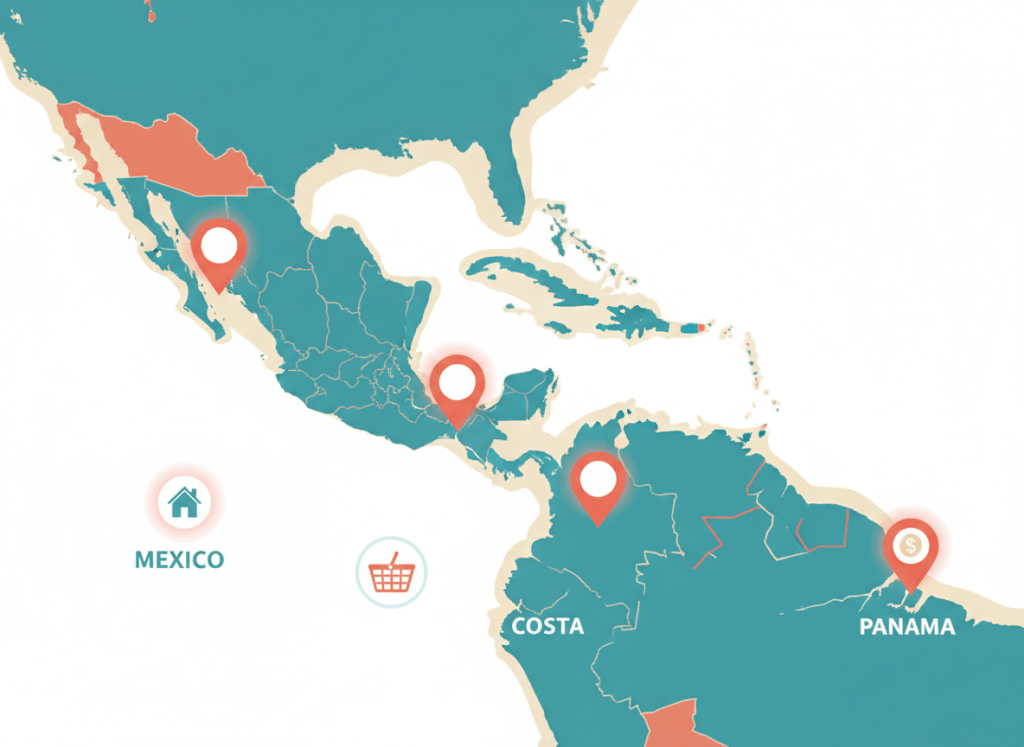
How does El Salvador compare with Costa Rica and Panama?
Day-to-day costs are lower than in both. Read our side-by-side comparison.
Sources
- DGME: temporary residence forms and requirements
- The Rio Times: Retire in El Salvador 2026 (September 22, 2026)
- Numbeo: Cost of Living in San Salvador
This guide is general information, not legal, immigration or tax advice. Consult a licensed Salvadoran immigration lawyer before applying.





Leave a comment